Showing posts with label New York. Show all posts

Wednesday, February 22, 2012

High Line Phase II

So despite the fact that the second phase of the High Line Park opened last summer, and I have been to NYC probably dozens of times since then, I had yet to visit the newest leg of the park, extending from 20th to 30th Street.  I finally got there last week (though sadly, idiotically, I forgot to bring a decent camera, so these pics are with my very old, very slow iPhone 3GS). 


For the most part, the second phase is more of the same, though there are some unusual changes to the previous plant palette (more on that in a future post).  But what I enjoyed seeing most was this fantastic bird coop/co-op.


Built with steel wires and rods, the structure most be relatively heavy (and thus stable) and no doubt it's on footings.  But yet the whole thing looks quite light.  It provides ample opportunity for perching and the assortment of small stakes and boxes allow passersby to deposit apple cores for the birds and for small amounts of water to collect.


My only frustration was that the bird apartments (there were two, on each side of the path) were placed, no: squeezed, on a straight and narrow part of the park, creating bottlenecking and traffic.  Not only does that placement stifle circulation, but I kinda want to see this structure over a larger area so that there's more opportunity for birds to visit, deposit seeds and create a more complete model of urban ecological succession, which is of course what the park is all about.  


The somewhat clumsy placement makes me wonder if this was not an add-on.  I can imagine a city agency or organization bringing this to the program after design was already complete, and the designers needing to struggle to find a place for it.  And don't get me wrong, I love the structure!  I just wish it didn't feel like it was shoehorned onto an existing design. 

Thursday, January 26, 2012

Finally! The USDA Hardiness Zone Map Changes

When I teach certain plants, I often find myself qualifying their hardiness.  I'll say things like, "Well, when I was in college, we were taught that Crape Myrtle would never survive in NY.   It's considered a solid zone 7 plant.  Yet, more and more, we see it in Manhattan gardens and in the Hamptons."  This was perplexing because New York was considered Zone 6 until yesterday.


On January 25, the USDA introduced an updated hardiness zone map, showing an upward shift of average lowest temperatures and thus generally making each zone shift north.  For example, whereas New York was Zone 6, it is now marked as Zone 7. 


The map itself debuted in 1960, and was revised in 1965.  In 1990 the map was updated, using data from 1974-1986.  This revision actually caused zones to skew lower, as during those years winters were particularly colder.  The current edition includes data from 1976-2005, and thus should have better average temperatures reflected in the map. The map is also clickable- so you can view insets of your state.


Wednesday, October 19, 2011

Celtis occidentalis

How in the world is it that I haven't yet blogged about hackberry, or Celtis occidentalis? While it's not a particularly great ornamental tree, this native is common in the mid-Atlantic and is an outstanding plant for creating butterfly habitat.  


Everyone knows that butterflies gather nectar from tubular flowers, so when I write about butterfly habitat, I'm speaking more about the habitat it provides for caterpillars and eggs, which is obvioulsy equally important.


I tell students that the bark of hackberry, which is very distinctive, looks like gray molding clay that someone has hacked up with a fork or knife.  But that's not at all why the common name exists.  Instead, it's derivative of the Scottish name 'hagberry' which is actually in reference to a cherry (Prunus) species. 


The word Celtis is derivative of ancient Greek for a tree with sweet fruit, and while there are berries on hackberry, I would leave them for the birds (and caterpillars).  Occidentalis means 'western' which can cause initial confusion for us folks on the east coast.  But in botanical nomenclature, western means the new world, not the west coast of the new world.


The specimen above is at the Smithsonian's Butterfly Habitat Garden, though the top photos are from Central Park.  The plant is prevalent in both locations, though one also regularly encounters C. laevigata or sugarberry.

Thursday, July 28, 2011

Plantain Weed

Yesterday I was in New York and it was a glorious morning for a run in Central Park.  The air was crisp and cool, a nice change from the record breaking heat we've all been enduring lately. While climbing Heartbreak Hill, I noticed these three ladies, collecting plants in the weedy turf. 


It turns out they were collecting all the above ground parts of Plantago major, or plantain weed.  The Asian ladies spoke very little English, but the youngest woman (they looked like they could have been three generations of the same family) was able to tell me they use this for tea.  A longer look online shows that the plant's leaves, when boiled with water, strained and cooled, can be helpful in aiding coughs, colds, dysentery, and possibly high blood pressure.  The leaves can be mashed into a poultice that reduces itching and swelling of skin irritations.  In fact, one of the less common monikers for this plant is 'Soldier's Herb' since it's been used for this manner on battlefields.


No doubt, you've seen this plant in less manicured lawns and fields.  The plant is native to Europe and Central Asia, but of course now it's found all over North America and other temperate areas. 

Friday, July 8, 2011

Stewartia pseudocamellia

Way, way back in May 2008, I wrote a post about Pinus bungeana or lacebark pine, and said "sooner or later I will post some Stewartia pseudocamellia photos, too.


And yet, I never did.  Shameful.  Shameful because Stewartia pseudocamellia is without a doubt, one of the most elegant, beautiful small trees. 


Most of these are shots of the specimen at the Conservatory Gardens in Central Park -- I've actually yet to see one in DC, but I have no doubt they exist.  It's a very small growing, compact, multistemmed tree.   So far, you may be thinking, nice, but whatev...
 

The foliage has deeply recessed veins and a minute serration along the edge - I like the textural quality it gives the plant. Part of the reason I haven't blogged about Stewartia was because I never had good pics of the plant in bloom until this summer.  I still don't have good fall color photos, but take my word for it - the rich red color is lovely, too. 

It's evident why the species name is pseudocamellia when one considers the blossoms.  Large, white, camellia-like flowers occur for several weeks in early summer.  Like camellias, they have very showy yellow stamens.  The plant can be a bit messy when the flowers fall to the ground, but to me it's worth a little cleanup.


And then of course, we have the bark.  People love the bark on crape myrtles, but they just don't compare to Stewartia's silvery, satin-like sheen.  The bark exfoliates, showing shades of peach, gray and sand, and has a wonderful, shiny surface.  Absolutely beautiful.  I tell my students that this is the Grace Kelly of trees -- it's a ridiculous statement, but I can't help myself.


Finally, none of this is to say the plant is too delicate -- I also see this growing 10' away from the Hudson River, in Battery Park, and it fares very well there.  Part of the reason it's not very popular is because it's expensive (i.e., slow growing), but as you can guess, I think it's worth it.

Wednesday, July 6, 2011

Bottlebrush Buckeye


Bottlebrush buckeye, or Aesculus parviflora is one of my favorite summer-flowering shrubs.  The one below is blooming at the Conservatory Gardens in Central Park.  If the genus name is familiar, that's because I've also blogged about Aesculus hippocastanum, or horsechestnut.  Like that species, this plant has opposite, palmately compound leaves, though A. parviflora is typically large, sprawling shrub, and A. hippocastanum is a tree.

Of course, the flowers are quite different too.  As the common name implies, the spikey infloresences look like bottlebrushes.  The species name, parviflora, means "small flowers" - as the individual flowers on this infloresence are quite small.


Now, I said that the plant is typically a sprawling shrub (it's also one of the very best plants to use in dense shade), but on a recent visit to Manor View Farms in Maryland the owner John showed me some unusual specimens he had that had been limbed up into treeforms.  It's killing me that I don't have a chance to use them on any current jobs - they make a lovely silhouette. 

Friday, April 29, 2011

Viburnum plicatum 'Popcorn'

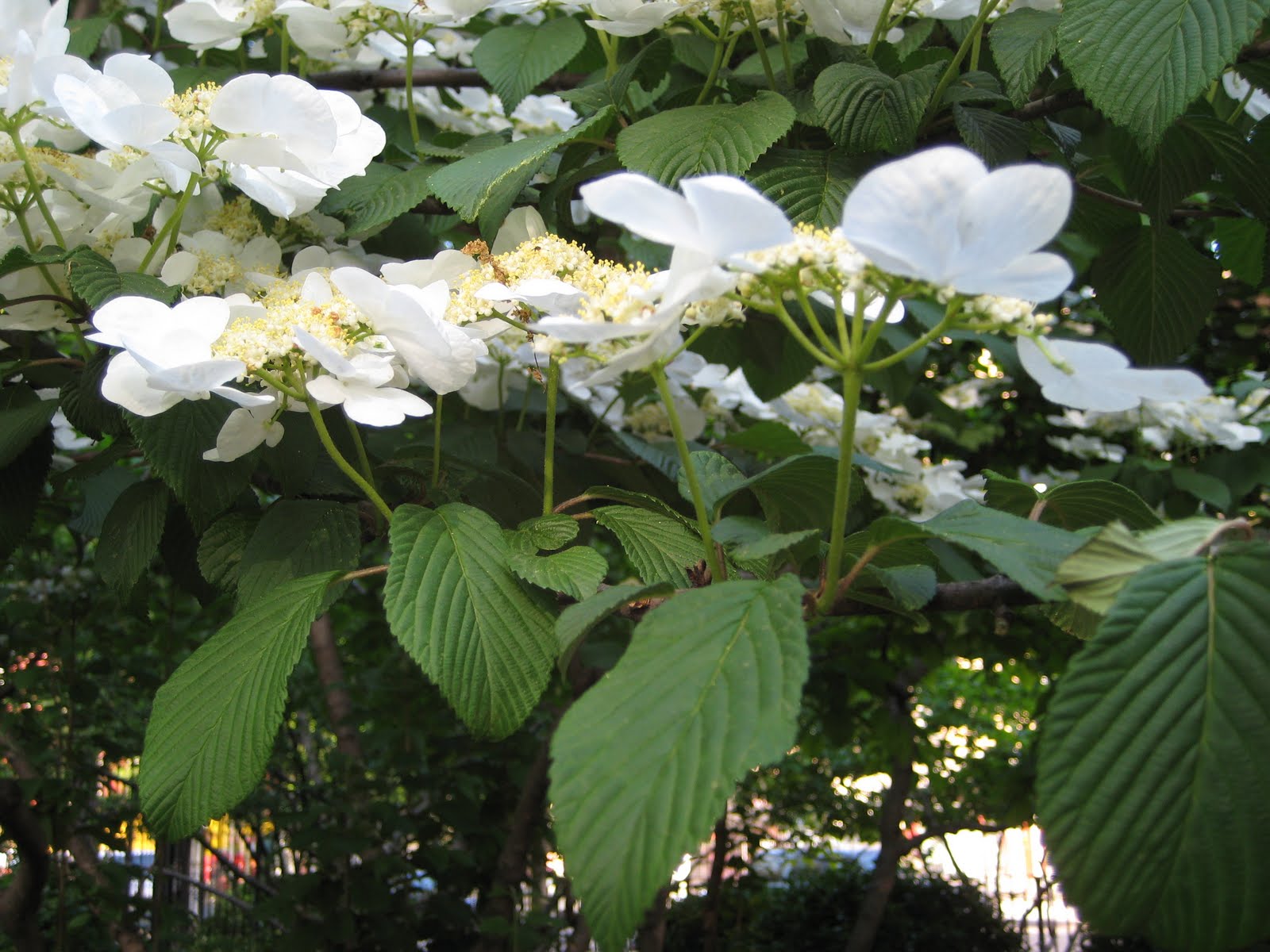
Viburnum plicatum - or doublefile viburnum - is a terrifically handy plant.  It's deer resistant, has great fall color and no real pest problems.  It's in bloom right now and typically can be spotted by its large, horizontal branches that seem to extend from the plant parallel to the ground plane, as you can see in this specimen at Tompkins Square Park in New York.


It's called doublefile because typically the flowers and the showy bracts appear in a double line along the branches.


The specimens below belong to the same species, but these cultivars are called 'Popcorn' -- because of the round head of flowers which are actually quite similar to a Hydrangea.


Though this plant is not native (it is from China) the berries it sporadically forms in the fall are good food for birds.  I also love the deeply recessed venation in the leaves -- a feature common in many Viburnum species.

Wednesday, April 13, 2011

Spiraea thunbergii

Here's another shot of one of the moongates in the Enid Haupt Moongate Garden at the Smithsonian yesterday.  Breaking up the mass use of Magnolia x soulangiana, we have a very lovely spring shrub that is stealthily eating visitors as they walk on the adjacent sidewalk.


Well, probably not, but you can probably guess from this pic that the plant is a "vigorous" grower.  It's Spiraea thunbergii or Thunberg Spiraea.  Most hobbyist gardeners know Spiraea but are probably more familiar with the summer blooming S. bumaldaS. x vanhouttei is another popular species.  But I have a soft spot for this plant. 


(By the way -- see something familiar peeking behind this plant??) I love the long slender stems that are densely packed with miniature rose-like flowers (indeed, this plant is in the Rosaceae family). The plant's been in bloom for a week or two now and the leaves are just beginning to emerge.  Narrow and lanceolate, they are also a great chartreuse shade of green that's much lighter than most shrubs. 


Spiraeas in general are bulletproof; they sustain drought easily and don't have any major pests or diseases.  Really the biggest hazard of having one is that it does need to be maintained.  If left unpruned it will get very scraggly and the inside of the plant will die off from lack of sunlight.


Below is one of my favorite uses of the plant -- it's a hedge at the Conservatory Gardens in Central Park.  It prunes easily and is so floriferous, that no matter when you prune it, it will still have a heavy flower set.  You can see that it's been probably a month or so since it was last pruned and the soft, fuzzy texture is such a nice change from yew and holly hedges. The shot below was taken in mid-summer and as you can see, the spring-green hue of the leaves has not darkened. 

Friday, March 11, 2011

Yellow Twig Dogwood

I was in New York earlier this week for a few meetings and was able to squeeze in a morning run in Central Park.  I stopped along the way to take this shot of Cornus sericea 'Flaviramea', or yellow twig dogwood.  That building beyond is the landmarked Majestic Building, one of the first deco residential structures in Manhattan. 
 

I blogged about Cornus sericea before (at least I'm 99% sure it was C. sericea  and not C. alba).  And while the red and yellow twig dogwoods appear so different, genetically they are within the same species.  'Flaviramea' is a cultivar that has been around for just over 100 years and while it is prone to cankers, it's a nice change of pace from the red stems. 


Like red twig dogwoods, this plant is more deeply hued after heavy pruning and can be quite striking in front of a green background, as it is above. 

Thursday, March 10, 2011

Spring Window Display

This was too cute not to share.  I saw it at the Gracious Home near Lincoln Center when I was in New York last week. 


Get it?  Bulbs, and bulbs?  I appreciated the wink that someone at Gracious Home was sharing with those of use who know what tulips grow from.

Tuesday, February 8, 2011

Bench Siting

When I worked at the Bronx Zoo, I drew up a lot of quick little construction drawings for the installation of benches throughout the park's campus.  In a million years, a sketch indicating this would never be approved. Anyone know why?


We always had to incorporate some kind of paving (ideally a porous one) underneath the bench.  The arrangement above (though lovely with the pink granite pedestals underneath each bench foot) would require to much maintenance.   Mulch would have to be re-applied and weeds would need to be combated (particularly in a sunny location like this).  Granted, the operating budget for the Sculpture Garden may very well exceed that of the Bronx Zoo's, but this detail just looks unfinished to me.


Above, at the Bronx Zoo, benches are sitting away from the main traffic path and elevated above Astor Court's historic granite curb.


At Longwood Gardens, the benches are sitting on platforms and pulled back from the path, so your knees aren't in traffic.


The detail above, at the Getty Center in Los Angeles, is even more elaborate.


 In Teardrop Park, the bench sits on a continuation of the sidewalk paving.


As it does at this church courtyard in Paris.

At the High Line,  the bench sits above a drain grate.

Finally, the bench I'd most want to sit on: a stone bench at Monet's home in Giverny, France has cobble paving to distinguish this from the main thoroughfare.

Tuesday, January 18, 2011

Lincoln Center Benenson Grove

When I was approaching the David Rubenstein Atrium space at Lincoln Center, I came across the new Charles B. Benenson Grove, near the south end of Lincoln Center.  The grove officially opened in May of last spring, and if you go to this link, you can see photos of it with the trees in leaf.  


From a distance, I immediately, unenthusiastically assumed that these trees were Carpinus betulus - the go-to plant for 'architectural' or 'contemporary' landscapes.  But the green-hued bark and the smaller buds quickly corrected that assumption.


A dried leaf - triangular in shape - was a clue that this was a species of aspen and indeed the literature on the aforementioned link names them as quaking aspens or Populus tremuloides.


A strange choice to me, since the trees (though lovely when the leaves flutter so easily in a summer breeze) are relatively short-lived and prone to pests and disease.  A colonial species, it's a tough survivor in its youth but as the plant ages it falls suspect to various problems.  Their placement also seemed curiously close together, considering they quickly can reach spreads of twenty feet.  As you can see, they are placed barely more than 5' apart.


Of course, I've already ranted today about overplanted areas once, so I don't want to belabor this point.  But, I think this planting could have been sufficient with probably half the specimens, unless of course the designers (uncredited in the link I posted above, but here Mathews Nielson is credited), anticipated that a percentage of the trees would fail more quickly than others. 


Indeed, wear and tear is already showing - I am really hoping that this damage occurred after construction and the construction administrator didn't miss out on rejecting such a rough-looking specimen! I'm curious what readers think -- I like Mathews Nielsen's work very much but am puzzled by this particular layout and species selection. 

Lincoln Center Facelift

I have to say, it's so nice to have Lincoln Center back, after what seemed like ages of construction! Here's a few shots of the pubic outdoor spaces. 


The steps now have lighted welcome messages.  If you've ever been to the Metropolitan Opera, you'd recognize the font below matches the subtitles you can opt to read during a performance. 


The plaza and fountain have been upgraded.  If you've never seen this plaza in person, you probably would recognize it from The Producers (go to minute 3:30 or so), Ghostbusters (go to 1:07) or Moonstruck (go to 4:56). 


The fountain is significantly different in that now a black disk hovers above the ground plane, where previously the fountain was in a black tub.


Water skims over a weir that is located directly underneath the outer edge of the disk.


Okay, so let's talk about the planting.  Below, you have - in a space not much bigger than 25'x25', THREE Taxodium distichum and a Gleditsia triacanthos var. inermis.  Too much!


I sympathize with the pressure to make a landscape look established and mature when there is a high- profile public opening, such as Lincoln Center's.  But, to see a strip like this so overplanted frustrated me. It happens more often than not and even with private clients, there is a demand for a garden to look instantly-established.  It's my hope that as landscape architects, we can continue to try to educate our clients, and the public at large, that a landscape takes years to come into its own and to exhibit a touch more patience!