Showing posts with label desert plants. Show all posts

Friday, April 8, 2011

Pachypodium

Since yesterday's post was on Vinca minor, a member of the Apocynaceae family, I thought I would post today on one of Vinca's odder relatives, Pachypodium.  I won't distinguish a species, however since I'm not so good at spotting the differences between P. lealii and P. brevicaule, though the former is more common in southern Africa and the latter is specific to Madagascar.
 

Pachypodiums are desert plants and you don't have to be a plant nerd to assume that the water the plant needs to survive drought is stored in the trunk.  Below, you can see the flower is not too different from Vinca.  
 

Though we think of elephants when we hear the word "pachy" - that's really Latin for "thick."  Thus, pachyderm means thick skin.  Pachypodium means thick foot (I suppose the "foot" in this case is the swollen trunk).

Monday, January 10, 2011

Somali Hemp


First of all, how evocative is that common name (Somali hemp)?  Immediately I think of drug-running pirates and gunfights and war.   None of those are good things, of course, but I didn't say it was a "good" common name either, just an evocative one...


Anyhoo, the botanical name for Somali hemp may be more familar: Sansevieria grandis.  Chances are if you've ever been to a mall (or my apartment, for that matter), you've seen its relative, Sanseviera trifasciata, which also has some scary-sounding common names: snake plant, or mother-in-law's tongue. 


S. trifasciata is a common houseplant, but Somali hemp, less so.  It is native to Kenya and south Africa and is in the Agavaceae family.  Its succulent leaves means it can survive a long time in hot, dry climates.  The genus is named for Italian Prince Raimond de Sansgrio de Sanseviero, an 18th century patron of botanical expeditions.

Tuesday, October 19, 2010

Mesquite

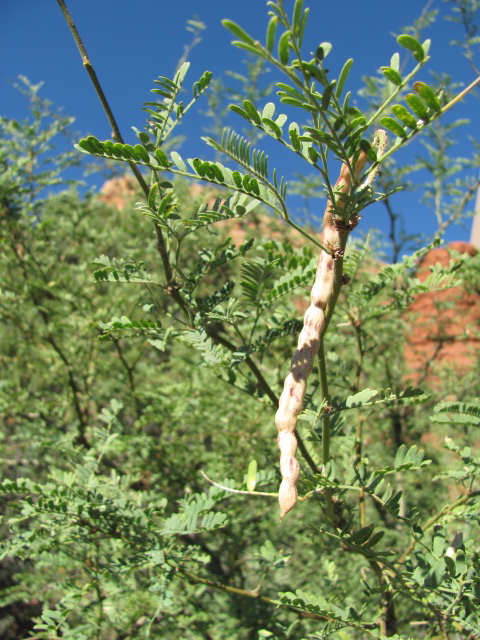
Below is a fairly elegant specimen of mesquite (Prosopis velutina) growing near town in Sedona.  More often than not, this shrubby tree has a much scrubbier appearance, but in either case it is prevalent in Sedona and the Sonoran Desert.  Prosopis is a member of the pea family and looks much like its relatives - it has pinnately compound foliage and, more to the point, it has bean-like fruit.


One of the common names is honey mesquite, because the beans themselves are incredibly sweet.  The tour I mentioned in yesterday's post also included a sampling of the mesquite beans and they tasted like sugary candy.  Indeed, the plant is eaten by livestock and has been key to survival of Native Americans during historically tough winters.  


The beans can also be ground into a flour called pinole and can then be used to make tortillas and cornbread, to name a few. They can also be fermented into a fizzy, alcoholic drink, though I didn't see this on the bar menus of any restaurants.


The Prosopis velutina is native to the Sonoran Desert, but other species of Prosopis include Prosopis glandulosa, in the Texas and Southern California deserts and Prosopis pallida, a South American native that is prevalent in the drier parts of Hawaii.  Below, a specimen of P. pallida grows on the Big Island


 Prosopis is the ancient Greek name for burdock and it's speculated that the genus was applied to mesquite due to some similarity between the flowers.

Monday, October 18, 2010

Prickly Pear

In addition to the saguaro, prickly pear must be one of the most recognizable American cacti.  This species is most like Opuntia engelmannii.  It's an invasive weed in Australia, South Africa and other regions that match the climate of the Sonoran Desert, as are many other species in this genus. 


I've seen this plant in Barcelona and New Jersey - both locations that are just not 'right' for the prickly pear.  But here, in the desert, it was a pleasure to observe.  The large, ping-pong paddle-like leaves are covered in long spines and in the spring, the plant has very large yellow flowers.  I was sorry to miss the floral display, but thrilled to see this plant in fruit.


We took an off-road jeep tour at sunset in Sedona - in the photo above our guide is harvesting a prickly pear for our sampling.   Even though the fruit appears to be spineless, it's actually covered in very small spines.  Grabbing this without the protection of gloves or a piece of paper would mean you'd be picking spines out of your fingers all day. 


Once you have a prickly pear in your hand, you can use a knife to cut away the skin, then scoop our the deep red, beet-colored flesh.  I wasn't sure what to expect but was surprised at how delicious the fruit is.  It's tangy and sweet, reminiscent of a plum, though it does have a grit to it from the seeds.


The fruit, which is commonly called 'tunas,' is used to make jams and, appropriately enough, to flavor margaritas. 


There are many species of Opuntia in the American Southwest.  The region I was visiting is most populated with O. engelmannii, but there is also O. phaeacantha var. discata (tulip prickly pear) and O. basilaris (beavertail prickly pear), which is spineless.


Opuntia is named for Opus, an ancient Greek city where cactus-like plants grow. 

Tuesday, October 12, 2010

Saguaro

I spent this past holiday weekend in Arizona and took hundreds of pics of the beautiful ecosystems there.  Our home base was in Sedona, but we spent time in the Grand Canyon and Phoenix as well.  Phoenix is in the northern limit of the Sonoran desert - known perhaps best for its most famous inhabitant, the Saguaro cactus, Carnegiea gigantea.


The saguaro is endemic to the Sonoran Desert, which stretches from Phoenix to northern Mexico.  Some occur near the lower Colorado River in California as well.  It's a massively tall tree, reaching heights up to fifty feet.  When you encounter one that tall, you can speculate that it's lived for as long as two hundred years. 


The tree's structure is not like a typical woody tree - instead the interior is comprised of wooden rods.  This allows the plant to expand and contract based on the amount of water it is storing.  Roots are shallow and stretch as far as fifty feet away from the trunk - this maximizes the amount of water the plant can capture during the rare rainfall.


The saguaro provides habitat to many desert birds, including gila woodpeckers and flickers, as well as desert raptors like elf and screech owls.  In addition to the many bird species found in the Sonoran Desert (350), there are 60 mammals, 20 amphibians, 30 fish and 100 reptiles.  In this little roadside park, I saw dozens of desert cottontails and greater roadrunners.


Here a younger saguaro is in the foreground to the right.  Saguaros must reach fourteen to sixteen feet in height (age 75, approximately) before it begins to branch.  


Saguaros are by far, one of the most iconographic American plants.  It's easy to overlook how big they get.  For precisely that reason, here's a shot illustrating its massive size.  For the record, I'm about 5'-3"!!